Noah Hiles: The NFL's international schedule has gone too far
Published in Football
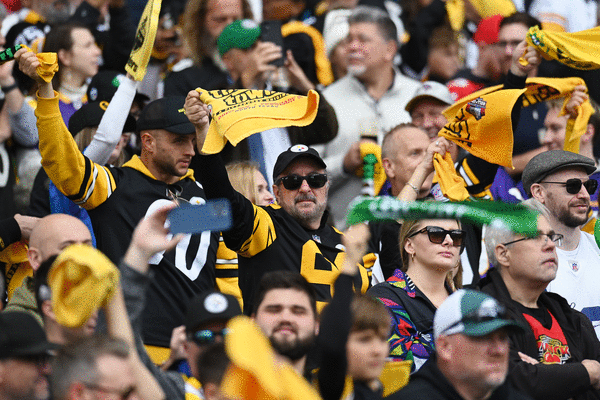
PITTSBURGH — Let’s start here: I’m very much a fan of international travel. While I personally haven't logged many trips outside these United States, I’m all for embracing the exploration of new places and cultures.
I should also note I love the game of football. This, similar to the one above, isn’t exactly a unique stance. There’s a reason why it’s our country’s most popular sport, with no competitor serving as a close second.
Over the past 20 years, the NFL has offered its fans an opportunity to embrace both of these things via the emergence of international regular season games. At first, it seemed like a win-win. Fans and players were provided a unique experience through a league initiative aimed at growing the game globally.
But now it’s worth wondering if things have gone too far.
On Thursday, the Steelers officially released their 2026 regular season schedule. The most notable game on the slate? A Week 9 showdown against the New Orleans Saints in Paris.
The matchup marks one of nine international regular season contests this year, which will take place in seven different countries. Something that once served as a novelty event has now become a regular part of the NFL calendar.
International growth seems to be one of the NFL’s primary goals, and it’s not difficult to understand why. There’s plenty of money to be made outside these United States, and no sports commissioner has been better at capitalizing on new revenue streams than Roger Goodell.
However, we’re reaching the point where money for the league is the only true reward for all parties involved.
The NFL became our country’s most beloved sports league for two reasons: simplicity and high quality of play. By continuously adding more international games each season, the league is diluting both of these key elements.
Football has always been the easiest sport to follow. Unlike baseball, basketball or hockey, your favorite team only plays one game each week. Growing up, my family had the same Sunday routine each fall: church in the morning, a quick lunch afterward and then rush home to be in front of the TV for 1 p.m. kickoff.
Even if the Steelers had a primetime game or were on a bye week, football was at the forefront of our household each Sunday afternoon. I’m willing to bet most of you reading this experienced something similar. But now things are a little different.
In 2006, the league added Thursday night games to its regular calendar. Originally, it was just a slate of eight games, all taking place in the back half of the schedule to build anticipation for the playoffs. By 2012, “Thursday Night Football” became a regular league fixture, starting in Week 2 and running through the entire season.
While we’ve since adjusted, willingly adding Thursday night to our weekly viewing calendar, I think most football fans would agree the event has more often than not been a lesser product.
The short turnaround is normally visible on the field due to players having less time to bounce back from the week-to-week grind of an NFL season. The stadium energy is often lacking, as well, as most fans have work the following morning.
We still watch. Most of us always will, regardless of when an NFL game kicks off or where it’s played — and the league knows it. It will continue to act upon this, even if it goes against what made the NFL so popular.
It seems like international games will soon become the new “Thursday Night Football.” 9:30 a.m. is quickly becoming the first regular viewing window, replacing 1 p.m. as the true beginning of a football Sunday.
International games, perhaps more so than Thursday nights, have regularly produced unmemorable contests. Players have frequently voiced their displeasure with the long travel midseason, as it further throws their week-to-week routines out of whack. They play poorly because of this.
Not as many folks will tune in. Some will still be at church. Some, especially those on the West Coast, will still be asleep. And others will simply wait until the higher-quality action gets going.
Nonetheless, money will be made.
Millions will still set their alarms, scramble to find the correct channel as they eat breakfast and place bets before the early morning kickoff arrives. Those with the financial means will schedule weeklong international vacations to support their team in a new venue across the globe.
The NFL’s popularity is so overwhelmingly large that we’re still a long way from there being any concern about packing a stadium for a special event. But eventually these events will no longer feel special. Eventually this will just be another game on the schedule, one fewer local fans can attend or even conveniently watch from home.
It will still have a net positive impact for the NFL, as the consistent presence across the globe will bring in a new wave of gridiron faithful. The league will then move on to a new initiative, one that perhaps makes regular season action a regular fixture on every day of the week.
It will further erase the very formula that once made the NFL the most entertaining and easy-to-consume sports entertainment this country has ever known. But there’s money to be made. And, in the end, that’s unfortunately what matters most.
____
© 2026 the Pittsburgh Post-Gazette. Visit www.post-gazette.com. Distributed by Tribune Content Agency, LLC.






Comments