Commentary: Tens of billions lost each year in US welfare programs -- and we're not even measuring it all
Published in Op Eds
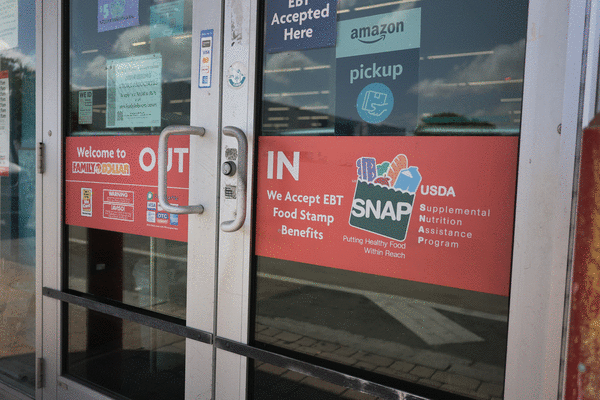
Last year’s welfare fraud scandal in Minnesota made headlines for its brazen nature and massive scale. But it’s only part of the story. Far more money slips through the cracks in the welfare system each year. No outrage ensues — but given the staggering sums involved, it should.
A recent report from the Government Accountability Office (GAO) sheds light on this waste. The GAO reports that in 2025, the government’s improper payments totaled $186 billion. Improper payments are those that went to an ineligible recipient, were made in the wrong amount or were made without proper verification.
More than 40% of these improper payments came from the welfare system:
--Medicaid: $37.4 billion
--Earned Income Tax Credit: $21.1 billion
--Supplemental Nutrition Assistance Program (SNAP): $10.2 billion
--Supplemental Security Income: $7.3 billion
--Additional Child Tax Credit: ≈ $3.6 billion
--Head Start: ≈ $1.3 billion
--Child and Adult Food Care Program: ≈ $400 million
--Foster Grandparents: ≈ $28.3 million
Total = More than $80 billion.
That’s enough money to provide the annual median household income for nearly 1 million American households. That’s more households than there are in Houston.
A small share of improper payments, 5%, were underpayments, and in some cases, it wasn’t clear whether a payment was improper or not. But 82% were overpayments.
Worse, the GAO says the amount of improper payments they found doesn’t “represent the full extent of government-wide improper payments.” Some government programs vulnerable to improper payments aren’t required to measure them.
And some programs aren’t required to report improper payments below a certain amount. Improper SNAP payments under $58 don’t have to be reported at all, but these smaller errors equal 38% of all improper SNAP payments.
As the GAO explains, “The federal government is unable to determine the full extent of its improper payments or to reasonably assure that it takes appropriate actions to reduce them.”
Improper payments aren’t the only way money gets lost in the welfare system. Most fraud isn’t even captured in improper payment reports. Improper payment measures are not designed to capture practices such as identity theft, provider billing fraud (for example, billing for services that were never provided) or SNAP benefit trafficking.
The U.S. welfare system is a maze of 90 programs that cost $1.7 trillion in 2025. The more money going into these programs — particularly those with high error rates — the more money available to be wasted on improper payments and fraud.
There’s little financial accountability in the welfare system due to its funding mechanism. Most welfare program money comes from federal coffers, but the programs are administered by states. If money is spent improperly or defrauded away, much of it isn’t states’ own money.
Starting later this year, states will be required to contribute some of their own funds to SNAP if improper payments exceed a certain threshold. A good reform. Ultimately, states should be required to match the federal dollars they receive with an equal amount of their own dollars. This would increase states’ financial accountability and provide greater incentive to protect SNAP dollars.
Other policy changes would help prevent fraud and waste in the U.S. welfare system.
In the Earned Income Tax Credit and the Additional Child Tax Credit programs—both essentially cash assistance programs with significant improper payments—most waste and fraud result from misreported income and people claiming children that do not meet residency requirements. Requiring better income documentation before payouts, such as 1099s for self-employment income, and only allowing those with legal custody to claim a child, could substantially reduce improper payments.
Ending “broad-based categorical eligibility” (BBCE) in SNAP would also reduce fraud. BBCE allows states to enroll people in SNAP without an asset test—making SNAP available to people who aren’t needy by any measure. It also weakens the verification process. Nearly all erroneous payments in SNAP come from those who entered SNAP through BBCE.
Implementing the National Accuracy Clearinghouse (NAC) in SNAP and other programs, provides a way for states to check whether people are enrolled in a program in more than one state. In 2018, Congress said states must begin implementing the NAC, but the process has been slow, with only 15 states having launched it so far.
Allowing states to keep money saved from fraud reduction measures to invest in further fraud prevention mechanisms could also help reduce fraud and waste.
Countless billions of dollars lost due to weak safeguards in the welfare system is unacceptable. We need to do more to reduce error or exploitation—and ensure that these programs serve those actually in need.
____
Rachel Sheffield is a Research Fellow in The Heritage Foundation’s DeVos Center for Human Flourishing.
_____
©2026 Tribune Content Agency, LLC.

















































Comments