Chicago restaurants and bars become spaces for political protesting: 'Everyone's experiencing some level of rage'
Published in Lifestyles
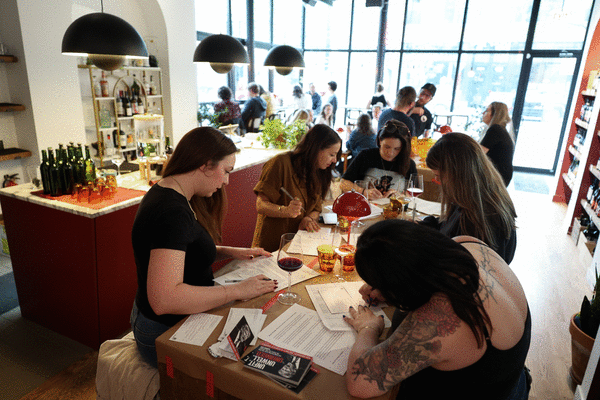
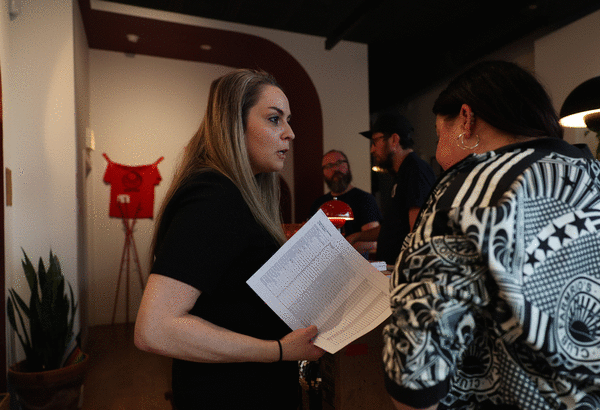

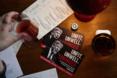
CHICAGO -- With a glass of white wine in one hand and a printed spreadsheet of names and addresses of around 50 lawmakers in the other, Allyssa Bujdoso was setting up for a crowd at Deep Red Wine Merchant in Avondale. A guy with a sign reading “(Expletive) Trump” rushed through the door, handed over a sheet of stamps and then hurried away.
“Oh wow, I actually saw him walking around this area yesterday and gave him one of our flyers to come and hang out with us,” Bujdoso said last Tuesday evening, peering over to see the unnamed activist scurry across the street. “This is what it feels like when we’re creating a community space … even though he didn’t stay!”
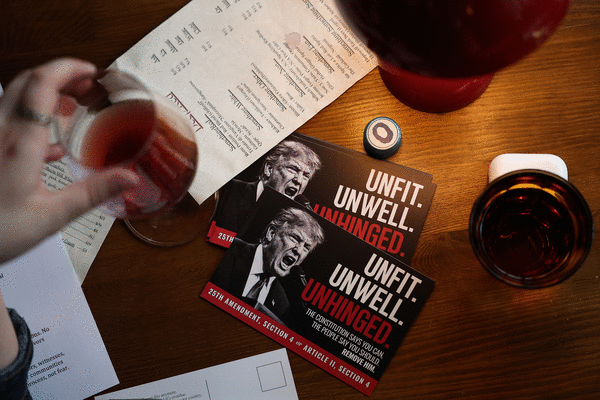
The stamps are for the stacks of postcards on the table in the middle of the bar that are central to the Chicago Postcard Protest series. The cards have a photo of President Donald Trump screaming into a mic, with three bold, uppercase words to the right: Unfit, unwell, unhinged. “The constitution says you can, the people say you can remove him,” printed on the bottom, as a nod to section four of the 25th Amendment.
Next to a pile of pens, there are multiple copies of a “shame list” Bujdoso created. The list, which Bujdoso compiles with blurbs about why various United States senators and congresspeople are problematic, makes it easier for attendees to “direct their rage” to the appropriate places, she said.
Bujdoso, an employee at a global content production company, started the project in April following her involvement in “whistle-mania” events to distribute warning kits for residents wary of Immigration Customs Enforcement. The event at Deep Red Wine Merchant was the organization’s third, with many more to come.
After Operation Midway Blitz last fall, Chicago’s local hospitality scene has become a central front in resistance against ramped-up federal immigration enforcement, combining community-driven economic support with food and shared meals or beverages.
The Chicago Postcard Protest is intended to offer residents another way to denounce the myriad social justice issues plaguing communities in Chicago and elsewhere. It’s especially appealing to folks who can’t physically protest in the streets but want to use their time and voice for the same causes, Bujdoso explained.
“Postcards physically take up space,” she said. “Sure, phone calls are great, a bit pesky for whoever has to write down everything in your message, but if you flood their desk with a ton of mail, that’s an even bigger inconvenience and that’s what we want.”
Bujdoso provides a sample prompt, but she prefers when attendees write from the heart, releasing built-up grievances against those currently in positions of power.
“Lindsey Graham gets a lot of postcards,” laughed Bujdoso, about the Republican senator from South Carolina who is a staunch defender of federal immigration agents. He was aggressively underlined on many of the attendees’ contact sheets.
Most of the postcards sent out last Tuesday dealt with matters of immigration enforcement, voter rights and a push in southern states to redraw electoral maps that would dilute the voting power of Black and brown voters.
Erin Bjorkquist from Logan Square said that “if those (senators and congresspeople) keep getting elected, that’s only going to keep us in this situation longer.” Bjorkquist, a “middle of the road” protester, brought her friend Julie Cwik to Deep Red Wine Merchant for an accessible way to support both a cause and a bottle shop.
Though visible immigration confrontations have faded since the height of the Trump administration’s Operation Midway Blitz last fall, Immigration and Customs Enforcement has taken on a “quieter” approach, focusing on street-level arrests, residential stops and targeting individuals at courthouses.
Bujdoso said the activist community and groups in Chicago’s hospitality industry are shifting their gears too, finding new outlets for resistance.
“The best thing we can do is be creative about how we’re pushing back against ICE and against the government,” she said. “If they’re going to try and surprise us, we’re going to try and surprise them … stir up some ‘good trouble.’”
Belmont Tavern owner Nick Kokonas, one of the four lead organizers of the Chicago Postcard Protest, along with Avondale Bowl co-owner Jeff Wilson and Deep Red Wine Merchant owner Dave Thompson, was thrilled to see the postcard stack getting shorter and shorter as people filled them out.
“There’s this idea that if you don’t like what’s going on, you can just call or email your representatives, but most people don’t do that. … You can send out an email that just goes to some sort of spam folder,” Kokonas said. “But with this initiative, it’s a very cathartic way to release how we feel and demand change, and to know that these postcards will land across some desk and people will see it.”
Melissa Clark, a Logan Square resident originally from Minnesota, took a deep sigh before putting pen to paper. Two places she calls home have been faced with unthinkable violence, she said.
“It’s one of those things that when you’re feeling helpless in a situation, this is a very, very simple thing that I can do instead of sitting at home spiraling or whatever,” Clark said. “It’s a good way to fill the time — everyone’s experiencing some level of rage right now.”
Within an hour, the space was filled with people scribbling down grievances over a glass of wine.
A week before the Chicago Postcard Protest event, another gathering in nearby Logan Square struck the same intentions. But the focus was a family-style dinner at an Anti-ICE Supper Club.
“It’s comforting to walk into a space where you know we’re all in agreement,” said Stacy Simpson, an Evanston resident seated at the supper club at LouLou by Lula Cafe, as she pierced her fork into a pile of butter-poached romaine and salmon. “Because even with our families now, we don’t know where everybody stands and it can be very contentious.”
Simpson and her husband were among the 52 diners at the dimly lit Lula Cafe spinoff space. The supper club, ticketed at $150 a person, was raising funds for the Illinois Coalition of Immigrant and Refugee Rights.
Many of the diners said they’ve been seeking out businesses and restaurants that align with their moral stance on things like immigration or war. Even a simple solidarity sign sometimes helps narrow down where to spend money, noted Lakeview resident Carol Fox.
“We all have to do something, and this is my little bit of something right now,” she said.
The supper club was presented by the food and travel media company Roads and Kingdoms, which hosted a Chicago run May 4-7 after a successful stint in the Florida Keys. The series is a small, but vital contribution to the fight for an America under attack, said Nathan Thornburgh, Anti-ICE Supper Club co-founder and Roads and Kingdoms partner.
“If you care at all about food, you have to care about the people who provide and produce it,” Thornburgh said.
It was the 12th Anti-ICE Supper Club event since federal immigration agents tore through immigrant communities nationwide. The concept itself, however, is in its second iteration.
In 2017, Roads & Kingdoms and the late Anthony Bourdain launched the “Banned Countries Dinner Series” in response to the first Trump administration’s travel bans. The dinners were specific to each individual culture in each country on the banned lists, including Yemeni and Sudanese chefs.
Now, the dinner is focused on the second Trump administration’s ongoing immigration enforcement tactics.
“We chose an aggressive name on purpose. We want to come out and find that there are entire restaurants, entire communities, entire groups of diners and workers who will stand together for a dinner that’s called ‘Anti-ICE,’” Thornburgh said. “That’s beautiful proof of the ongoing strength of our First Amendment rights.”
Thornburgh said he’s always believed that food is the best way to get people to care about a particular issue — a way inside conversations that unveil what’s wrong with societies near and far. He said his old friend, Bourdain, felt the same.
“I miss him terribly and I miss his ability to be very succinct and unerring in the moral clarity of what needs to be said,” Thornburgh said. “We don’t know what he would say now, but we did know one thing — he really did not like Trump.”
Diners at LouLou by Lula Cafe raised their glasses to Bourdain and to ICIRR, an organization at the forefront of helping families in the Chicago area navigate the legal system after an ICE encounter.
Alex Miller, development manager for ICIRR, said all the money raised at the dinner went toward ICIRR’s deportation defense work and rapid response programs. And a lot of that work begins with the family support hotline, which received over 27,000 calls between last September and now.
“We’ve been doing this work for many years, but it has obviously become much more necessary with an incredible influx of calls and need for our work,” he said. “Last year was incredibly bad, and luckily, (ICE) kind of pulled back at the moment, but we’re not resting on our laurels. We are building up the fences, we still have a number of hotline operators employed, and we have trained over 25,000 people in this work to respond.”
Jason Hammel, chef and owner of the popular farm-to-table Lula Cafe, which won the 2024 James Beard Award for Outstanding Hospitality, said the supper club was a perfect fit for them.
“We’re concerned about supporting the people who have been impacted by (immigration enforcement) and this is one way that we can do that, through food and cooking for people who feel the same,” Hammel said. “The meal is designed to bring people together in a common call for a common cause — a shared value.”
Ann Torralba was seated at a six-person table at the Anti-ICE Supper Club alongside her husband, Patrick Milani, with a front row seat to the open-concept kitchen where Hammel was piling canoe-harvested wild rice and ramps onto plates.
Torralba, who is Filipino, said she’s deeply invested in the experiences of her fellow immigrants and jumped at the opportunity to support ICIRR and LouLou/Lula Cafe, which have been vocal supporters of minority groups in Chicago.
The couple lives in the Hispanic-heavy Hermosa neighborhood and has seen the impact that immigration fears have had on their neighbors, beyond just the blow to businesses and foot traffic in the area.
“It’s sad because there is a disconnect that people don’t understand — diversity makes cities what they are, the cultural contributions (of immigrants) are significant,” Torralba said. “They’ve had to be careful… hide, these are our friends, wonderful people in our community just trying to survive and have better lives for their children. They’re not the enemy, they’re not the criminals.”
Chicago’s run of the Anti-ICE Supper Club featured four restaurants, including Hermosa, TXA TXA Club and Gilda. The next slate of cities for the series will be held in Philadelphia and Denver, with restaurants and dates to be announced soon.
____
©2026 Chicago Tribune. Visit at chicagotribune.com. Distributed by Tribune Content Agency, LLC.

















Comments