California family alleges ICE beat father in front of daughter before deportation
Published in News & Features
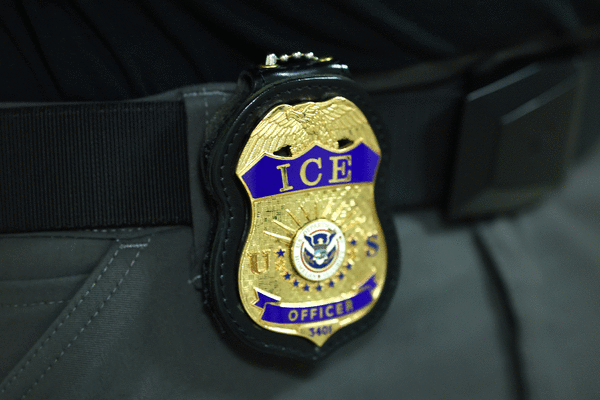
SAN JOSE, Calif. — A deported Sunnyvale carpenter and his U.S. citizen family are suing the federal government and two private prison companies, alleging ICE agents beat him during a violent arrest last year before he was denied proper medical care for months in immigration detention.
The arrest spurred South Bay protests of the immigration enforcement effort last year.
The lawsuit, filed Monday in U.S. District Court on behalf of Ulises Peña Lopez, his wife, Aby Peña, and their daughter, names as defendants the Department of Homeland Security, ICE and private prison companies GEO Group and CoreCivic.
In February 2025, Peña Lopez was surrounded by masked ICE agents in tactical gear as he sat in his truck outside his family’s Sunnyvale apartment, preparing to go to work, the lawsuit in San Jose federal court said.
An ICE officer struck the driver’s side window of Peña Lopez’s truck repeatedly with a baton, and cracked it, the lawsuit says. When Peña Lopez stepped out of the truck, several officers grabbed him, it says. His wife, a U.S. citizen, was blocked by ICE agents and watched from the top of a staircase, according to the lawsuit.
“One officer put a gun to his head,” the lawsuit alleges. “Others forced him to the ground. ICE officers then jerked Ulises up off of the ground and rammed him against the car while beating him with closed fists, striking multiple blows to his ribs and neck.”
His daughter, identified in court documents as “E.P.,” a U.S. citizen, “witnessed everything and was sobbing” as she looked from the window of her family’s second-story apartment, the lawsuit says.
Peña Lopez’s lawyer in the lawsuit, Elena Hodges of Pangea Legal Services, a San Francisco nonprofit that represents immigrants in complex immigration and legal matters, said his marriage to a U.S. citizen doesn’t confer protection from deportation. Peña Lopez was “undocumented” at the time of his arrest. The lawsuit does not contest his removal from the U.S.
Peña Lopez and his family are seeking unspecified damages and a court order declaring that conditions at two detention facilities where Peña Lopez was held are unconstitutional because he was deprived of due process and adequate health care in alleged violation of the Fifth Amendment.
Federal officials disputed the lawsuit’s framing and emphasized Peña Lopez’s criminal history. A Homeland Security spokesperson, who did not identify themself, said Tuesday that Peña Lopez, 31, was a “criminal illegal alien from Mexico with prior arrests” who had entered the U.S. illegally in 2013, was arrested by border agents and “released into the country by the Obama administration, unvetted.”
Homeland Security staff “always use the minimum amount of force to safely deescalate situations,” the spokesman said.
The lawsuit says the agents screamed at Peña Lopez in English, which he didn’t understand.
While the lawsuit alleges ICE beat Peña Lopez, the agency said he failed to follow agents’ instructions. ICE did not address the question of whether Peña Lopez was beaten, but said it “does not comment on pending litigation.”
ICE said in a statement Thursday that when agents confronted Peña Lopez, he “initially did not comply with officers’ repeated instructions to exit the vehicle,” but got out “when officers attempted to extract him.”
“Criminal illegal aliens are not welcome in the United States, and ICE is working diligently to remove them,” ICE said.
Santa Clara County Superior Court records show Peña Lopez was convicted in 2020 of misdemeanor assault involving his girlfriend — now his wife — in 2019 in a Palo Alto apartment. Police records from the case said she told officers he choked her while holding a handgun to her throat and threatening to kill her. He completed a one-year domestic violence program and was sentenced to three years of probation and ordered to pay $3,740 in restitution.
Peña Lopez’s lawyer Hodges noted that “the judge in the case found that the conduct wasn’t severe enough to warrant any jail time.”
In 2020, Peña Lopez was sentenced to 14 days in jail for driving under the influence after crashing into a traffic-light pole in Mountain View.
“When a community member serves their time in prison or jail and earns their release, they should be able to reunite with their family and contribute to our communities,” Hodges said. “ICE cannot be allowed to subject anyone in our communities to state violence regardless of whether they’ve been arrested or convicted in the past.
“ICE’s attempt to focus on Ulises’s criminal history shouldn’t be allowed to distract from what this case is actually about: the severe harm that ICE officers and private detention contractors have subjected this family to, from the violent ICE arrest to the many months of disability discrimination and other abuses in detention.”
In the transport vehicle after his arrest, Peña Lopez, who in 2024 suffered an ischemic attack — commonly called a “mini-stroke” — from an artery torn through lifting heavy objects in his job, began convulsing, the lawsuit says.
“The officers opened the van doors and pulled Ulises out, throwing him from the vehicle,” the lawsuit states. He tumbled handcuffed from the vehicle about 4 feet to the ground, where he hit his head, the lawsuit alleged.
“The ICE officers began kicking and beating Ulises, punching him in the ribs, stomach, arms, legs, and neck,” as agents screamed insults and threats, the lawsuit alleges.
An ICE officer put his hand onto Peña Lopez’s throat and leaned all his weight on it, cutting off Peña Lopez’s air supply, the lawsuit alleged.
“He lost consciousness twice during the beating,” the lawsuit alleges. ICE called paramedics, and “while the paramedics were on the way, Ulises lost consciousness and was not breathing. An ICE officer initiated CPR.”
Paramedics drove Peña Lopez in an ambulance to the emergency room at El Camino Hospital in Mountain View, the lawsuit says.
ICE said that shortly after Peña Lopez was arrested, he “experienced a medical emergency, was transported to a hospital and treated.”
Late the next night, Peña Lopez was transferred to Golden State Annex, a detention facility and former state prison near Bakersfield, owned and operated by federal contractor GEO Group, the lawsuit says.
GEO Group failed to perform an adequate health and disability screening of Peña Lopez, who was having severe chest pain, breathing trouble and neurological symptoms, the lawsuit alleges, adding that he collapsed in the recreation yard the next day. At a nearby hospital, he was discharged with instructions that he needed a follow-up appointment with a primary care provider within one or two days, but Golden State Annex staff never provided it, or the “heart healthy” diet hospital staff had prescribed, the lawsuit alleges.
Peña Lopez was confined in freezing temperatures with lights on all night, and was denied access to a phone and outdoor space, the lawsuit says.
GEO Group did not respond to requests for comment.
Homeland Security said “any claims of subprime medical care at ICE facilities are false,” and that it is a “long-standing practice to provide comprehensive medical care from the moment an alien enters ICE custody.”
In late August 2025, Peña Lopez was transferred to California City, another former state prison southeast of Bakersfield, owned and operated at the time by CoreCivic.
The lawsuits calls the conditions at the facility “horrendous.”
At California City, the lawsuit alleges, Peña Lopez went a month without daily medication, was denied prescribed heart-healthy meals and saw his symptoms worsen because of inadequate medical treatment and disability accommodations, the lawsuit alleges.
CoreCivic said detainee safety and health are top priorities and that the company follows detention standards set by its government partners. CoreCivic spokesman Ryan Gustin said detainees have “daily access to sign up for medical care, including mental health services,” and receive three nutritious meals a day.
In October, Peña Lopez was deported to Mexico, where his physical and mental health have “continued to deteriorate as a direct result of the violent ICE arrest and subsequent lack of proper medical treatment and disability accommodations throughout his detention,” the lawsuit alleges.
The lawsuit alleges he has struggled to find work and still has trouble walking because of the beatings.
His wife has been diagnosed with post-traumatic stress disorder, anxiety and depression, and “continues to experience pervasive emotional distress, nightmares, grief, and worry for her husband and daughter,” the lawsuit says.
Back in Sunnyvale, his daughter has “regressed in her development,” and often wakes in the middle of the night “screaming and crying,” the lawsuit says. One morning, according to the lawsuit, her mother found E.P. in the corner of the living room, “crying and hugging a photo of her father.”
©2026 MediaNews Group, Inc. Visit at mercurynews.com. Distributed by Tribune Content Agency, LLC.






Comments