Iran war saps US military ahead of any potential China conflict
Published in News & Features
A top Pentagon official’s remarks that the U.S. had halted arms sales to Taiwan to ensure sufficient munitions for the Iran war are the latest sign that the conflict has sapped American military readiness, including for a potential confrontation with China.
“We’re doing a pause in order to make sure we have the munitions we need for Epic Fury,” Acting U.S. Navy Secretary Hung Cao told U.S. lawmakers on Thursday, referring to the U.S. campaign in the Middle East.
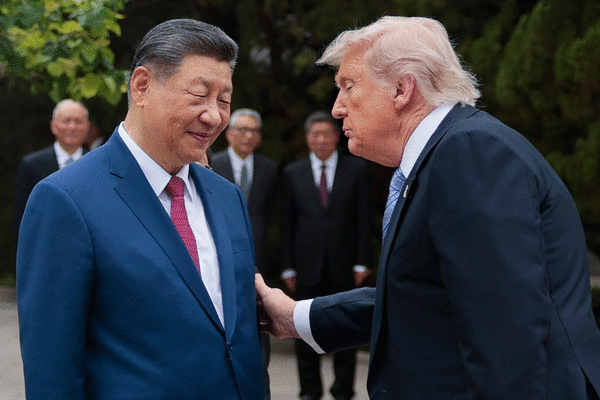
The comments underscore the toll the war of choice in Iran has taken on U.S. inventories. Last week, China’s Xi Jinping warned President Donald Trump that misunderstandings over Taiwan could lead to U.S.-China “clashes.”
Throughout the nearly three-month war, the U.S. has burned through an astonishing amount of munitions, lost dozens of aircraft and drones, and suffered damage to hard-to-replace radars and regional bases. It’s also led to extended deployments for costly U.S. warships. Keeping ships at sea longer than planned can have cascading effects that limit future deployments for years, according to a person familiar with the matter.
The sheer volume of bombs, missiles and air defense interceptors used in the war — at least 13,629 munitions by mid-May, according to one Pentagon official — has drained the U.S. arsenal, caused a political headache at home and highlighted the cost of taking on even a comparatively weak conventional military. It suggests the U.S. might need to rethink how to approach a near-peer competitor such as China.
“The high tempo of U.S. operations, and high rates of munitions fired, means the U.S. is stretched thin and mortgaging future readiness to deal with the issues of today,” said Bloomberg Economics defense lead Becca Wasser. “That could render the United States to be less prepared to contend with future challenges, including China.”
At least two dozen U.S. warships have been involved in the conflict so far, with the Navy now orchestrating a full blockade of Iranian ports.
U.S. Navy ships operate on a complex three-year schedule of deployment, training and maintenance called the Optimized Fleet Response Plan. It limits ship deployments to seven months and allows for periods of non-deployed readiness when they can “surge” into action.
Yet the USS Gerald Ford aircraft carrier was dispatched to the Middle East after being sent to the Caribbean to help pressure Venezuela. And during its 326-day deployment, the $13.2 billion vessel suffered an extensive fire in its laundry area and had to leave the fight for repairs at a Greek port.
“Between this and the operations in South America, you’ve got a certain ratio of operational time to maintenance time that has to be maintained,” said Tom Shugart, a former U.S. Navy submarine captain now at the Center for a New American Security. “I would never say to not fight a war because of your maintenance schedule. But that bill is going to get paid at some point.”
The lack of shipyard space and trained workers means there is also limited flexibility to navigate extended deployments or other setbacks, said according to the person familiar with the matter, who asked not to be identified because of the sensitivity of the issue. The Navy doesn’t publish its maintenance and deployment schedules.
The Pentagon didn’t immediately respond to a request for comment.
The effect on stockpiles of long-distance strike weapons is even more stark. The U.S. used about 1,100 of Lockheed Martin Corp.’s JASSM-ER cruise missiles and about 900 RTX Corp. Tomahawks, said a person familiar with the arms stockpiles. Only a few hundred of those missiles are manufactured annually.
The Pentagon has moved to boost production of these weapons, but the burn rate has become controversial. Trump argued in the early days of the conflict that the U.S. had a “virtually unlimited supply of these weapons.”
Air-defense interceptors, which proved crucial against Iranian drone attacks in the Gulf, present an even thornier bottleneck with thousands of valuable Patriot PAC-3 missiles fired and fewer than 700 produced each year.
Defense Secretary Pete Hegseth has dismissed the issue when questioned by lawmakers. “The munitions issue has been foolishly and unhelpfully overstated,” he said this month. “We know exactly what we have. We have plenty of what we need.”
But bringing weapons stocks back to prewar levels will cost at least $8 billion and take years at current production rates, according to Pentagon procurement data. Wartime losses of MQ-9 Reaper drones alone have amounted to nearly $1 billion.
“Right now the U.S. military is unlikely to have the number of munitions and platforms to fight China the way it has always talked about fighting China,” said Greg Malandrino, a former Navy officer and senior fellow at the Center for Strategic and Budgetary Assessments.
The U.S. could still make a Taiwan invasion “incredibly challenging for the Chinese,” he added, but would not be able to fight for long.
Since taking power in 2012, China’s Xi has directed a sweeping military modernization that’s included a dramatic expansion of the country’s missile capabilities.
There are no signs China plans to invade Taiwan anytime soon. Xi has signaled a preference for using pressure to control the island and has stepped up his isolation of Taiwanese President Lai Ching-te on the world stage.
For the U.S., the conflict in Iran is “bad for readiness for a protracted war, that is, more than say a week,” said Peter Layton, a former Royal Australian Air Force officer and a visiting fellow at the Griffith Asia Institute.
Between those strains and China’s pressure on Taiwan, he added, “that’s a bad place to be.”
(Courtney McBride contributed to this report.)
©2026 Bloomberg L.P. Visit bloomberg.com. Distributed by Tribune Content Agency, LLC.






Comments