NATO welcomes Trump troop pledge as allies caught off guard
Published in News & Features
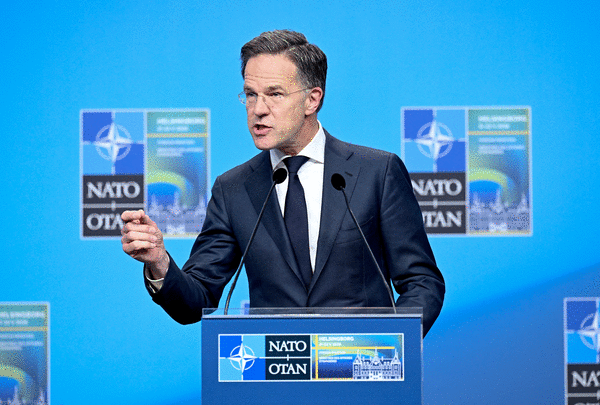
NATO Secretary General Mark Rutte welcomed an abrupt announcement by President Donald Trump to send an additional 5,000 troops to Poland even as the alliance’s top envoys braced for cuts in U.S. military resources.
As allies process the latest White House policy shift, Rutte said focus remained on boosting spending to be able to defend European security as the U.S. demands other nations work to protect themselves instead of relying on Washington.
“The money is really coming in,” Rutte told reporters in Helsinborg, Sweden on Friday as NATO foreign ministers gathered. Europeans are meeting their commitment to ratchet up investment to 5% of economic output on defense-related spending, he said.
Trump’s social media announcement Thursday on the new troops that will be sent to Poland — reversing a previous plan to suspend an Army deployment — increased a sense of confusion within the alliance. Officials had been rattled by sudden U.S. decisions on troop reductions in Germany and Poland as a result of Trump’s anger at what he perceives as European reluctance to support his warn in Iran.
U.S. Secretary of State Marco Rubio said the broader trajectory on U.S. redeployment was not “punitive,” but reinforced Trump’s position: “Frankly, disappointment at some of the NATO allies” for their lack of action.
“It is confusing, indeed — and not always easy to navigate,” Swedish Foreign Minister Maria Malmer Stenergard told reporters on the latest announcement. Several ministers said that they would prefer U.S. moves to be coordinated.
Trump said the move was tied to Poland’s election last year of a nationalist president, Karol Nawrocki. The Polish head of state, a Trump ally, had been blindsided by the U.S. announcement that it was suspending the deployment of a brigade combat team to Poland.
Asked about the unpredictable nature of Trump’s decision making, Poland’s foreign minister, Radoslaw Sikorski, responded that it has the effect of making Russian President Vladimir Putin “very uncomfortable.” The defense minister, Wladyslaw Kosiniak-Kamysz, said planning for a new deployment will take two to four weeks.
Foreign ministers were laying the groundwork for a July 7-8 NATO leaders summit in Ankara, where the alliance plans to showcase increased military capabilities from European allies. Trump, who has repeatedly thrown the U.S. commitment to NATO into question, has made greater spending among allies centrla to his approach to the alliance.
“When you look at Europe from the U.S. side, the demands are quite understandable,” Latvian Foreign Minister Baiba Braze said.
On Friday, the U.S. is expected to announce adjustments to national forces set to be made available in case of crisis or war, according to people familiar with the matter. Washington is now expected to cut the troops in NATO’s force model, which isn’t expected to immediately affect troops now in Europe.
Colonel Martin O’Donnell, a senior U.S. Army officer and spokesman for NATO’s Supreme Headquarters Allied Powers Europe, told Bloomberg that the U.S. announcement would focus on areas where it views Europeans as able to replace capabilities.
----------
—With assistance from Milda Seputyte and Eric Martin.
©2026 Bloomberg L.P. Visit bloomberg.com. Distributed by Tribune Content Agency, LLC.






Comments