Supreme Court says cruise lines are liable for using confiscated port in Havana
Published in News & Features
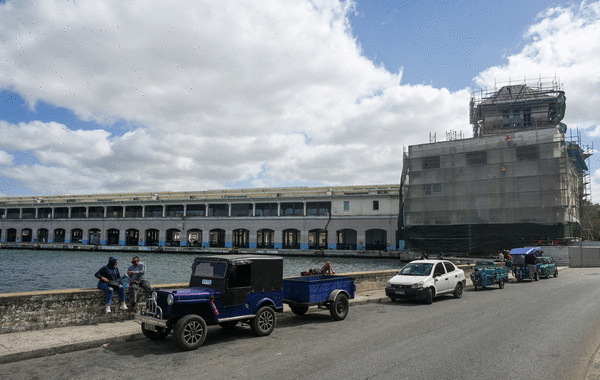
In a landmark decision several years into fierce litigation, the U.S. Supreme Court on Thursday reversed an appeals court order that had tossed a $400 million judgment against four cruise ship companies that took passengers to Cuba and were sued for damages for “trafficking in confiscated property” by an American company owning a concession at the port of Havana.
The decision clarifies that U.S. nationals holding claims to confiscated property in Cuba tied to time-limited concessions can also sue under the 1996 Helms-Burton Act, even if the company allegedly trafficking in such property is doing so after the original concession would have timed out.
At the core of the case is one of Cuba’s most important transport hubs: the port of Havana.
U.S. company Havana Docks had a concession to operate and develop the port of Havana that ended after the Cuban government confiscated the docks and port facilities in 1960 shortly after Fidel Castro took power.
Since the Helms-Burton Act was signed in 1996, successive American presidents had suspended a provision, Title III, that allowed U.S. nationals to sue companies “trafficking in confiscated property” by the government of Cuba. In May 2019, for the first time, President Donald Trump enacted the provision, and Havana Docks shortly after filed a lawsuit against Carnival, Norwegian, Royal Caribbean and MSC Cruises for using the confiscated docks to carry passengers to Cuba.
Miami federal Judge Beth Bloom had ordered the companies to pay $439 million, plus attorney fees and costs, finding that they engaged in tourism, which is prohibited by law, and hence could not claim they were exempted from the Helms-Burton’s trafficking provisions. But in a 2-1 decision, the Atlanta-based 11th Circuit Court of Appeals reversed the Florida judge’s ruling, arguing that because Havana Dock’s concession would have ended in 2016, the cruises sending passengers between 2016 and 2019 did not engage in “trafficking.”
“We disagree,” said the Supreme Court in an 8-1 decision written by Justice Clarence Thomas. “The Act generally makes those who use property tainted by a past confiscation liable to any United States national who owns a claim to that property. Havana Docks did not have to prove that the cruise lines interfered with a property interest that would have existed in the counterfactual scenario in which the Cuban Government did not confiscate it. Instead, Havana Docks had to prove only that the cruise lines used confiscated property — such as the docks — to which Havana Docks owns a claim. We therefore vacate the Court of Appeals’ decision.”
The justices said they rejected the appeals court’s analysis. Justice Elena Kagan filed a dissenting opinion.
“We decline to adopt an approach that appears to read out of the Act cases of trafficking that should be in the heartland of Title III,” the justices wrote.
The decision comes at a time the Trump administration is pressing the Cuban government to settle 5,913 claims for confiscated properties in Cuba — which were certified by the U.S. Foreign Claims Settlement Commission — and is threatening foreign companies doing business with Cuba with sanctions.
The decision did not settle the case, since other aspects of the lawsuit are still in litigation, but it provided a stunning legal victory to Havana Docks, which filed one of the first two Helms-Burton lawsuits in 2019.
©2026 Miami Herald. Visit at miamiherald.com. Distributed by Tribune Content Agency, LLC.






Comments