Uganda urges US to rethink funding cuts as it battles Ebola
Published in News & Features
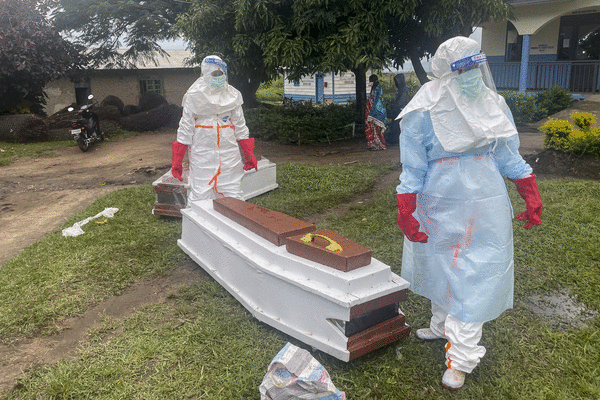
Uganda urged the U.S. and other partners to reverse deep cuts to global health funding, warning the pullback may hamper efforts to contain imported Ebola cases linked to an outbreak in neighboring Democratic Republic of Congo.
Sudden reductions in support for disease surveillance and healthcare programs have left African countries more exposed to epidemics, especially rare Ebola strains that lack approved vaccines or treatments, Information Minister Chris Baryomunsi said Thursday.
“The reduction should have been gradual,” Baryomunsi, a public health specialist said in an interview from the capital, Kampala. The cuts — most of which were announced last year — should not have been made “abruptly, because that creates huge gaps which can cause a crisis within our communities,” he said.
The outbreak of the rare Bundibugyo strain of Ebola has killed 139 people in Congo since the first cases were reported on May 15. The first confirmed cases were reported on May 15, and it’s already the worst outbreak since 2018-20, when almost 2,300 people died in Congo’s North Kivu and Ituri provinces. Uganda has recorded infections of two people — both linked to travel from Congo — in the latest flare-up, one of whom died.
Years of support from the U.S., the European Union and multilateral agencies had helped African countries strengthen HIV/AIDS, tuberculosis, malaria and epidemic surveillance programs, Baryomunsi said. Those resources have since been pared back following the U.S. withdrawal from the World Health Organization and the Trump administration’s cuts to foreign aid operations.
The minister welcomed a U.S. State Department announcement on Tuesday that it will help establish as many as 50 Ebola treatment clinics in Congo and Uganda through the United Nations Office for the Coordination of Humanitarian Affairs. For now, Uganda is relying largely on its own health system to manage the outbreak.
“At the moment we are managing all the cases using our health facilities,” he said. “But definitely any support that comes to establish treatment centers will be welcome.”
Uganda and the U.S. in December signed a bilateral health cooperation deal worth about $2.3 billion over five years — less than what the U.S. previously provided. It focuses on HIV/AIDS, tuberculosis, malaria, maternal and child health, polio and disease surveillance.
The current disease outbreak involves a strain related to the Bundibugyo Ebola virus first detected in Uganda in 2007. There are no approved vaccines specifically for this strain.
Beyond the two imported cases, the authorities in Uganda has placed 65 contacts in quarantine at isolation centers in the capital, Kampala. No additional infections have been confirmed.
Uganda has intensified temperature screening and surveillance from border crossings to schools, but has stopped short of restricting travel or other activities. Some large public events have been canceled, while officials are considering whether others — including the Rwenzori Marathon in August that draws international athletes — should be postponed.
For now, Baryomunsi urged tourists and international visitors not to cancel travel plans, saying containment measures remain in place and the situation is under control.
©2026 Bloomberg L.P. Visit bloomberg.com. Distributed by Tribune Content Agency, LLC.




Comments